



Research Update
Coral Reef Targeted Research and Capacity Building for Management
Over one-half
Coral
of the world's population lives
Reef
within 100 kilometres
Targeted Research &
Capacity Building for Management
of the sea.
Coral Disease Working Group
Causes, origins and impacts
of coral disease worldwide
Management Implications
Coral diseases potential y impact
both wel -managed and unmanaged
reefs indiscriminately. However,
strategies for dealing with disease
outbreaks are currently nonexistent.
The increasing frequency with which
diseases influence and alter reef
communities (Aronson and Precht
1998; Harvel et al., 1999, 2002;
Weil et al. in press) necessitates their
consideration and incorporation in
management plans. The proposed
study addresses this need by
providing the scientific background
eil
W
to formulate recommendations for
managers and policy makers. For
Ernesto
instance, correlations between water ge:Ima
quality and disease prevalence are
of growing concern but evidence of
The Coral Reef Targeted Research and
Background
Preliminary surveys in Australia
Capacity Building for Management
direct links and synergistic effects are
(and Lipscomb 2001, Dinsdale,
Program (CRTR) is a leading
limited (Kuta and Richardson 2002;
Over the last 20 years, coral reefs
2003), the Philippines (Raymundo,
international coral reef research
initiative that provides a coordinated
Porter et al., 2001). In addition, the
have been under increasing stress
et al., in press), and E. Africa reveal
approach to credible, factual and
role of coral community structure
from natural and anthropogenic
significant and damaging new
scientifically-proven knowledge for
improved coral reef management.
and diversity in maintaining
causes, including climate warming,
diseases in all locations surveyed.
productive fish and invertebrate
poor water quality and over-
The recent observations of disease
The CRTR Program is a proactive
research and capacity building
populations is wel documented,
fishing (Bryant, el al., 1998). Coral
in these regions is potentially a
partnership that aims to lay the
but links between these aspects
cover has declined significantly,
harbinger for increasing outbreaks
foundation in filling crucial knowledge
gaps in the core research areas of Coral
and coral diseases are general y
particularly in the Caribbean (Green and impacts associated with
Bleaching, Connectivity, Coral Diseases,
unstudied. As many MPAs are
& Bruckner 2000, Richardson &
increased climate warming.
Coral Restoration and Remediation,
Remote Sensing and Modeling and
established specifical y with the goal Aronson 2003). Over this same
Decision Support
of protecting the fishery in mind,
period, an unprecedented increases Current research supports a
Each of these research areas are
diseases that alter a reefs' ability to
in coral disease has contributed
connection between climate
facilitated by Working Groups
support a diverse fish population
significantly to the loss of coral
warming and increased incidence
underpinned by the skills of many of the
world's leading coral reef researchers.
is of concern. Understanding
(Richardson 1998a; Porter, et al.,
of disease on both land and the
The CRTR also supports four Centers of
the specific ways in which coral
2001). Disease outbreaks cause not ocean (Harvell et al. 2002; Harvell
Excellence in priority regions, serving as
important regional centers for building
diseases can alter reef function will
only coral loss, but they can result
et al., 2001). Disease outbreaks are
confidence and skills in research,
al ow better predictive power for
in significant changes in community threshold phenomena associated
training and capacity building.
conditions under which outbreaks
structure, species diversity and
with warming environments in
The CRTR Program is a partnership
may occur, and the rationale to apply abundance of reef-associated
many ecosystems, but coral reefs
between the Global Environment
Facility, the World Bank, The University
pressure to policy makers and local
organisms. While diseased-related are among the most susceptible
of Queensland (Australia), the
government to improve waste water damage of coral reefs has been
due to a very narrow thermal
United States National Oceanic and
Atmospheric Administration (NOAA) and
treatment, solid waste disposal and
well documented in the Caribbean
threshold for coral health (Harvell
approximately 40 research institutes &
land use practices.
(Rodriguez-Martinez, et al. 2001)
et al., 2002). The coral bleaching
other third parties around the world.
the status of disease throughout
observed worldwide following the
the Indo-Pacific is largely unknown.
October 2006
1998 El Nino was the most massive
www.gefcoral.org
Research Update
Coral Reef Targeted Research & Capacity Building for Management
and devastating ever recorded
W
(Hoegh-Guldberg 1999). It appears
To fill critical information gaps
o
that the death of some of the coral
RKI
was accelerated by opportunistic
about coral reef disease, build
pathogens.
ng g
capacity internationally, and
Deteriorating environmental
conditions could influence
develop solutions for managing and
disease by altering host/pathogen
R
interactions. For example, ocean
conserving reef ecosystems.
o
warming could affect basic
UP
biological and physiological
go
properties of coral, thus influencing
the balances between opportunistic
pathogens and the coral's ability
A
to fight them (Harvell et al. 2002;
l
Rosenberg & Ben-Haim, 2002).
Environmental factors could also
alter the surface mucous layers
(SML) of coral organisms. These
mucous layers harbor a normal
Major Areas of Research
and communities at local and
microbial flora that protects
geographic scales (Richardson
the coral against pathogen
1. Global Impact of Coral
1998). Recent results show that
invasion. Other stresses include
Disease
surviving coral of some species
nutrient loading, which could
affected by disease are non-
enhance pathogen growth, and
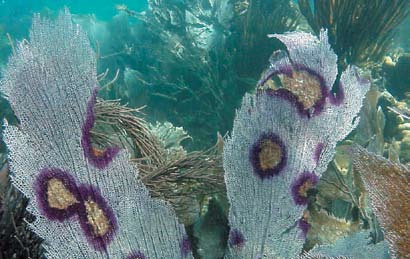
Coral disease stands out as a
reproductive, adding urgency to
sedimentation, which could
primary factor in the deterioration
documenting direct impacts (Petes
decrease coral resistance.
of many Caribbean coral reefs.
et al, in prep).
(Weil et al. in press). While the
The etiological agents of most
incidence and impact of disease
· Hypothesis 1: Disease is changing
coral diseases are unknown.
on coral reefs in the Pacific remains
the structure and composition
Reservoirs have only been
unknown, our preliminary surveys
of coral assemblages in all reef
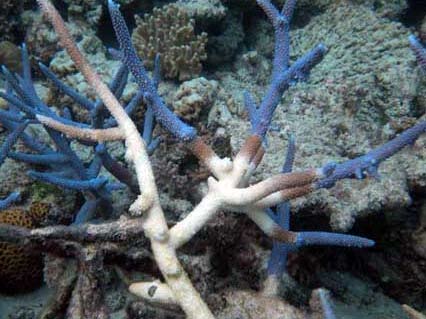
identified for 2 diseases: black band in Australia and the Philippines
regions
disease (Cooney et al. 2002) and
reveal significant new diseases
aspergilliosis (Shinn et al. 2000),
· Hypothesis 2: Disease is
(Willis et al. 2003, Raymundo et
and the only coral disease vector
changing coral reef biodiversity
al., in press). Baird (2000) recently
to be identified is the fireworm,
detected white spot I and II on the
· Hypothesis 3: Disease changes
(Hermodice carunculata) which
Great Barrier Reef, and Dinsdale (in
reproductive output, as well as,
harbors a bacterium that induces
press) reported black band disease
the dynamics of coral populations
bleaching (Sussman et al. 2003).
and white syndrome on the Great
Research strategies: We propose
Key objectives must be met to
Barrier Reef. These widespread,
an annual census at approximately
better manage reef ecosystems
intensive outbreaks may alter
24 sites globally. At each location
under newly intensified disease
the composition, structure, and
(e.g. Philippines, Central Visayas,
pressure. Exploring even basic
dynamics of coral populations
Palau, Hawaii, Australia, Caribbean)
questions is hampered by 1) lack of
resources, 2) the global nature of
the problem and 3) lack of expertise
and technology in developing
countries where many reefs are
located.
This cooperative research
effort is being guided by a
team of internationally known
microbiologists, ecologists and
physiologists We will test specific
hypotheses about climate and
anthropogenic changes threatening
coral reef sustainability. By building
the capacity to manage these
ecosystems, we hope to enhance
reef resilience and recovery,
worldwide.
Willis
B
ge:
Ima
www.gefcoral.org
we will measure disease impact and
prevalence to catalogue existing
diseases and investigate impact
of disease. We will work at 9 GIS
North
registered sites per locale with both
North
Pacific
Ocean
high and low water quality. Surveys
MESOAMERICA
Atlantic
Ocean
are underway; team members have
PHILIPPINES
already collected initial data in the
EAST AFRICA
Caribbean and Australia.
Indian
South
Ocean
Pacific
South
2. Global Warming &
Ocean
Atlantic
SOUTHERN
ocean
GREAT BARRIER
GREA
Anthropogenic Inputs
REEF
Centers of Excellence
The Global Assessment is designed
Existing Interconnectivity
to catalogue disease syndromes
Hypothetical Sites
Hypothetical Interconnectivity
worldwide for the first time and
reveal whether disease outbreaks
are correlated with climate warming
anomalies. There is evidence
communities in coral mucus,
Richardson, 1995) and possibly for
for this in the mass mortality of
water and sediment between
aspergil osis (atmospheric African
the gorgonian coral Briareum
sites with different loadings and
dust, which contains spores of the
asbestinium following the 1998 El
to assess changes in microbial
fungus, Aspergil us sydowi ; Shinn
Nino event (Harvell et al. 2001).
communities between healthy
et al., 2000). The only coral disease
An increase in disease following
and bleached corals. We will use
vector that has been identified
warming events may be because
multiple regression analysis to
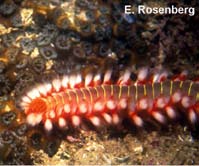
is the fireworm, Hermodice
corals are less able to fight disease
evaluate climate and anthropogenic carunculata, which has been found
while under temperature stress, or
influences on changes within
to harbor Vibrio shiloi (the pathogen
because bacteria are more virulent microbial communities.
inducing bacterial bleaching in a
(Alker et al. 2001; Ben-Haim et al.
Mediterranean coral) in its guts
in press). In at least three cases,
(Sussman et al., 2003). Other good
(Aspergillus sydowii, Vibrio shiloi,
candidates include snails, parrot
and Vibrio corallilyticus) pathogen
3. The Causes, Reservoirs &
fish and damsel fish, which directly
growth and/or virulence factors
Vectors of Coral Disease
interact (predation, grazing, etc.)
increase to an optimal temperature Current research on disease
with coral colonies of the most
(Isrealy-Tomar et al. 2001; Banin, et
reservoirs and vectors is hampered
important reef-building species.
al. 2000).
by lack of knowledge of the
· Hypothesis 1: Specific coral
While correlations between poor
pathogens causing the majority of
predators and grazers act as
water quality (nutrient loading
coral diseases. To date, there are
vectors and/or reservoirs for coral
and sedimentation) and disease
only 5 coral diseases for which the
diseases.
prevalence are of growing concern, microbial cause is known: black
evidence of direct links and
band disease (Cooney et al. 2002);
· Hypothesis 2: Reef sediments
synergistic effects are limited (Kuta
white plague type II (Richardson
are major reservoirs of coral
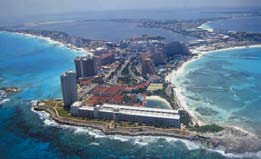
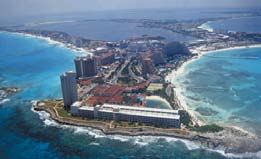
Aerial photograph of hotel development in Cancun,
and Richardson 2002; Porter et
et al. 1998), aspergil iosis (Smith
pathogens.
Mexico adjacent to coral reefs
et al. 1998; Nagelkerken et al.
© Wolcott Henry 2001
al., 2001; Kim et al, in prep). This
Research strategies: We wil first
survey will explore the interactions
1997; Geiser et al. 1998), white
develop a suite of techniques
between anthropogenic stressors
pox (Patterson, et al. 2002) and
to facilitate the identification of
and disease load.
bleaching of Oculina patagonica
pathogens in coral. Because only
by Vibrio shilio (Kushamaro, et al.,
· Hypothesis 1: Coral disease
a smal percentage of bacteria
1997). Disease reservoirs have
prevalence correlates globally
in nature are culturable, we will
only been identified for black band
with warming trends
confirm the identity of and track the
disease (biofilms in reef sediments,
source of pathogens using various
· Hypothesis 2: Coral disease
which contain non-pathogenic
molecular fingerprinting techniques.
prevalence correlates regionally
aggregates of the BBD; Carlton &
The development of genetic probes
with changes in climate and
and pathogen-specific antibodies
environmental quality.
wil also help verify the presence
· Hypothesis 3: Disease prevalence
of pathogens. These probes will
and changes in coral mucous
then be utilized to trace the route of
communities correlate locally with
pathogen transmission and identify
point source inputs
vectors and reservoirs of infectious
agents. Eventual y a micro-array
Research strategies: At each
chip of global coral disease wil be
site, we will measure nitrogen and
developed.
sediment loading. We will use
molecular and enzymatic assays to
E Rosenberg
assess differences in the microbial
ge:
Ima
www.gefcoral.org
Research Update
Coral Reef Targeted Research & Capacity Building for Management
4. Coral Resistance to Disease
The microbial communities
associated with corals are very
complex (Rohwer, et al. 2002),
existing both inside the coral animal
and in the surface mucous layers
(SML). These normal communities,
which may be specific to their host,
protect the coral from disease.
When the community structure
changes, corals may become
more susceptible to disease. Both
bleaching and disease appear to
change the microbial community
profiles in the SML.
Mechanisms of inherent host
resistance among corals are
effectively a black box; we lack
understanding of basic disease
resistance mechanisms and their
interaction with environmental
stressors. While the first line of
defense against pathogen invasion
is probably the establishment
of a healthy normal microbiota,
some cellular defense mechanisms
have been described. Both anti-
bacterial and anti-fungal activities
have been found in extracts from
gorgonians (Jensen et al 1996; Kim
et al. 2000a) and scleractinians (Koh
and Sweatman, 2000) and in the
case of sea fans, the response is
oup
inducible (Kim et al 2000b). Petes et
al. (in prep) reports the production
of chitinase, melanin and an
inflammatory reaction in infected
te
sea fans.
orking Gr
· Hypothesis 1: Environmental
upda
stress can cause changes in
mucous microbial communities.
Aerial photograph of hotel development in Cancun,
Mexico adjacent to coral reefs
· Hypothesis 2: Changes in the
© Wolcott Henry 2001
mucous microbial community are
correlated with disease.
· Hypothesis 3: Climate
into a chip of biomarkers for
Coral Disease W
Causes, origins and impacts of coral disease worldwide - research
and anthropogenic stress
stress (through collaboration with
compromises coral immunity and the CDHC). Field sampling will
Further Information
facilitates disease outbreaks.
eventually allow us to estimate
Disease Working Group
Research strategies: Various
clonal variation in sea fan
Cornell University
Chair: Dr C. Drew Harvell
molecular approaches will be
resistance, quantify the response
Email: cdh5@cornell.edu
employed to assess changes within of corals to different experimental
Co-Chair: Dr Garriet W. Smith
the microbial mucous communities
treatments of enhanced nutrients
University of South Carolina
in stressed, diseased and healthy
and temperature, and map spatial
Email: smithres@usca.edu
corals.
variation in resistance in the field.
Project Executing Agency:
Coral Reef Targeted Research &
The goals of the immunological
Capacity Building for Management
Program
work, starting with gorgonian
C/O Centre for Marine Studies
seafans as a study system,
The University of Queensland
Working Group Members:
St Lucia QLD 4072
are to develop assays for
Australia
prophenyloxidase (PPO), chitinase
Drew Harvell1, Garriet Smith2, Farooq Azam3, Eric Jordan4, Esther Koh5, Laurie Raymundo6, Eugene Rosenberg7, Ernesto
Weil8, Bette Willis9
Telephone: +61 7 3365 4333
and general antimicrobial activity.
Facsimile: +61 7 3365 4755
Once resistance compounds are
1Cornell University, USA , 2University of South Carolina, USA, 3Scripps Institution of Oceanography, UCSD, USA, 4Estacion
Email: info@gefcoral.org
identified, they will be incorporated Puerto Morelos, Mexico, 5Singapore, 6Silliman University Marine Lab, Philippines, 7Tel Aviv University, Israel, 8University of
Puerto Rico, USA, 9James Cook University, Australia
www.gefcoral.org